The Model Collapse series presents a visual field at once opulent and destabilized—a hybrid of mechanical anatomy, botanical form, and painterly distortion. Rendered as a digital jacquard tapestry, this series embodies a layered temporal logic: contemporary digital collage translated into one of the oldest mechanical image-making traditions, the woven textile. This medium is no passive substrate. The warp and weft themselves become part of the epistemological proposition: a coded, binary surface where images do not simply sit but are structurally embedded and materially encoded.
Model Collapse
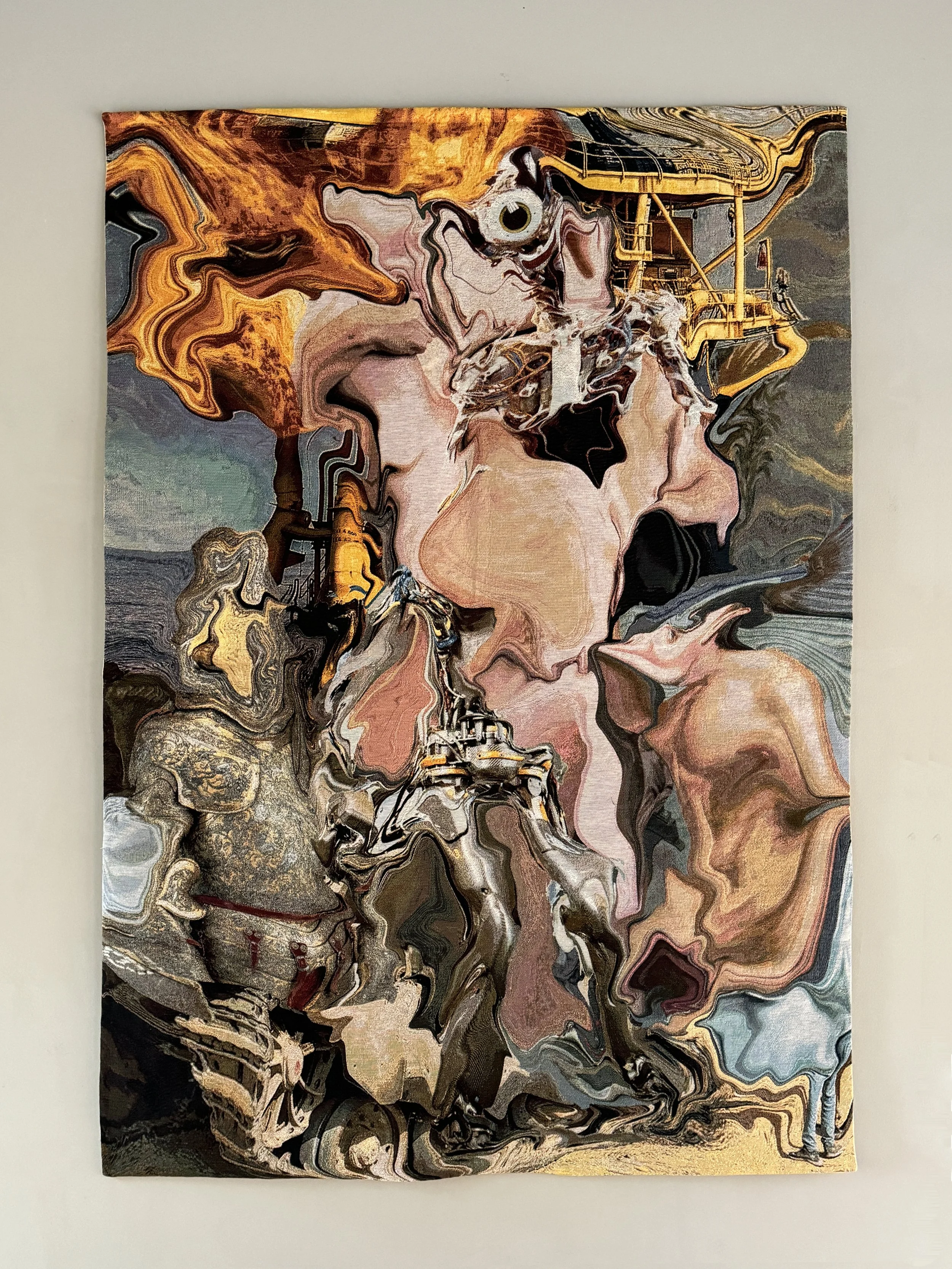
The compositions draw upon the formal conventions of painting traditions only to disrupt them. Blossoms surface with synthetic textures; petals articulate into armored joints; root systems mutate into chaotic wiring. Flesh, mineral, nature, and chroma interpenetrate with a fluidity that resists categorical reading. Nothing is incidental. Each fragment is manually selected, placed, and distorted in an iterative process that reacts to the visual logic of machine learning while refusing its statistical convergence.
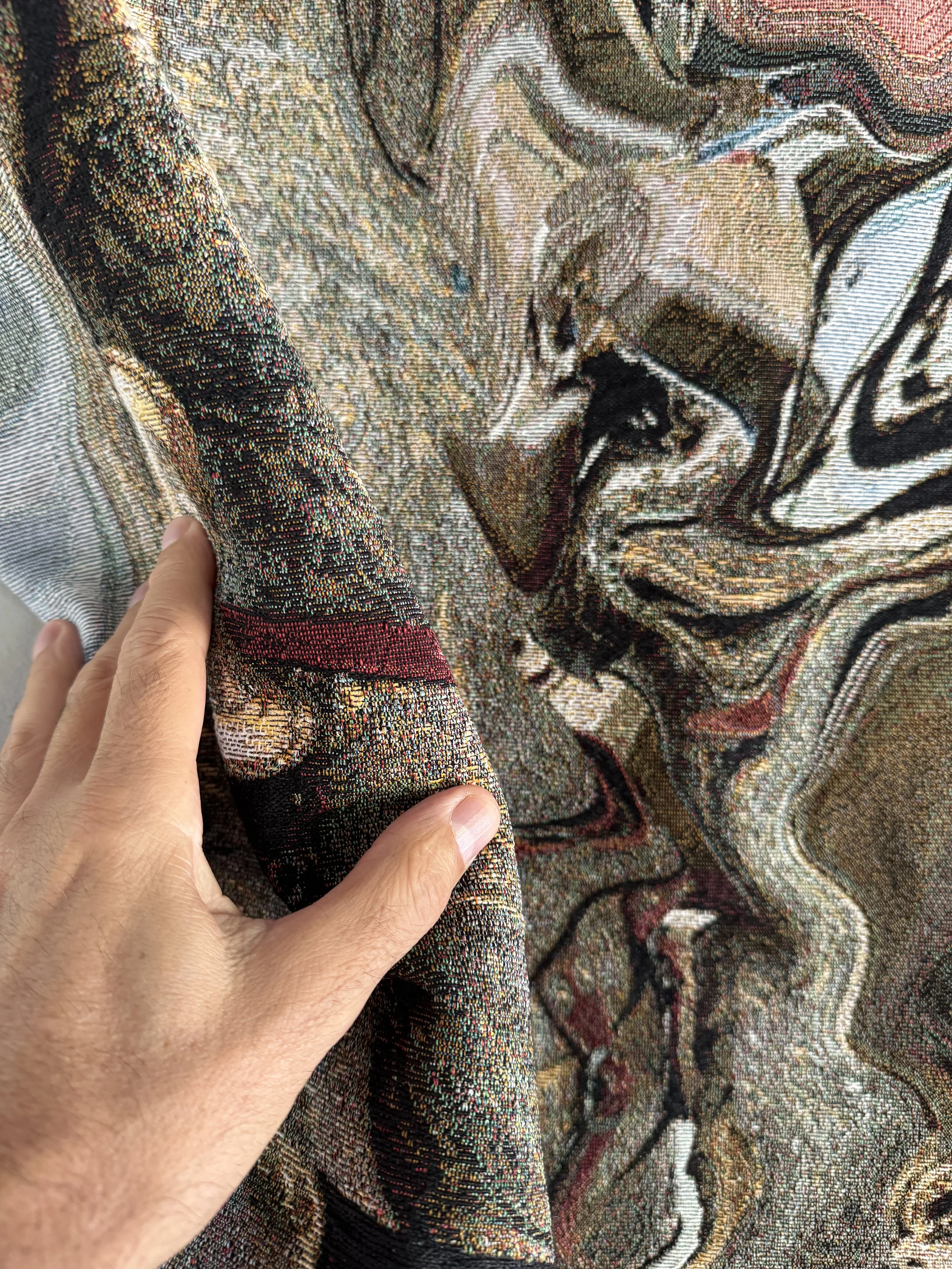
The work operates within the condition of algorithmic culture: infinite reproduction, compression, recursion, aesthetic smoothing. It does not position itself outside this field. Yet what appears to be a digital mutation is neither automated nor generative. The distortions and adjacencies are hand-directed and their affect deliberately calibrated. What reads as hallucination is embodied insistence or an assertion that perception, memory, and emotional specificity exceed systems calibrated toward prediction. AI produces images through convergence. These proceed through friction, misalignment, and sustained dissonance.

This refusal is not nostalgic. As predictive systems increasingly structure economic exchange, political discourse, ecological modeling, and cultural production, convergence becomes a governing logic. Flattening masquerades as clarity. Optimization replaces ambiguity. The blur in Model Collapse is ontological, not aesthetic. It marks the instability of frameworks that once organized meaning: nature and machine, figure and ground, sacred and synthetic. Rather than restore those hierarchies, the work inhabits their erosion.

A distant Romantic gravity lingers. There are echoes of Caspar David Friedrich refracted through the accelerationist unease of Future Shock, but sentimentality is absent. In extending what Max Ernst described as “complete transmutation,” Model Collapse disassembles the ground of encounter itself. The improbable collision no longer occurs between objects arranged upon a stable surface; the surface no longer holds.

What emerges is not chaos but a provisional order—polymorphic and exacting. The work exposes the limits of predictive systems not through rejection, but through pressure. Collapse is not treated as a catastrophe, but as a condition that reveals structural weakness. From that exposure, another structure takes hold, formed through contradiction and resistant to flattening or optimization, grounded in the entanglement of human and more-than-human experience.